Contemplative Handbook
Understanding Existence
Seventeen chapters tracing the journey from fragmentation back to wholeness - Christ's teaching as description of the actual operating structure of human life.
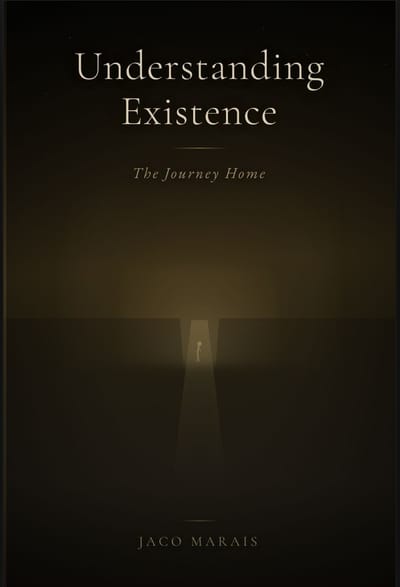
We live in an age of profound fragmentation — disconnected from ourselves, from one another, from God, and from the created world. The symptoms are everywhere: anxiety, loneliness, purposelessness, the quiet sense that something essential has been lost. But what if the problem is not complexity, and the solution is not self-improvement?
Understanding Existence proposes that human life has an actual operating structure — and that Christ's teaching corresponds precisely to that structure. Not as religious opinion, but as description of how things actually work.
Across seventeen chapters, this book traces the journey from fragmentation back to wholeness — through presence, relationship, surrender, and participation in the life the human being was made for. Drawing on depth psychology, contemplative theology, relational neuroscience, and transpersonal studies, it offers not a programme but a map: one that points the reader home.
This is not a self-help book. It is an invitation to inhabit reality as it actually is.
Excerpts
Author's Note
I do not think the forgetting is unusual. I think most people are doing something similar every day. Many have forgotten who they are so completely that they move through their lives in a dream state with their eyes open. This book is for them. It is also, honestly, for me. It is not written by someone who has completed the journey. It is written by someone who was found in the middle of it. And who is still, slowly and with considerable help, finding their way home.
Chapter 5 — The Isolation Cycle
Human beings are not designed to process intense internal experience without relational grounding. The nervous system depends on the regulating presence of safe others to maintain the stability required for integration. When that presence is lost, when the relational web thins to the point where the internal experience is being processed entirely alone, something shifts in the quality of the inner world itself. It intensifies. What was perception becomes amplification. What was insight begins distorting toward self-reference. The inner world grows louder and more consuming precisely as the outer world becomes less available to moderate it. And the person who began the process seeing more clearly than those around them gradually loses the external anchor that distinguished genuine perception from the noise the isolation itself is generating.